Orchestrating 10 AI Agents to Clear a Year of Technical Debt
Teams of agents running in parallel will make backlogs a thing of the past. Backlogs are so 2024...
Orchestrating AI Agents to Clear a Year of Technical Debt
In 2025 I had a problem; one of my side projects had accumulated the kind of backlog that hurt to look at. Hundreds of small tasks, each trivial, but collectively painful. Bug fixes, UX polish and minor refactors that never quite made it to the top of the priority list.
So I built a system to throw AI agents at it. Ten at a time. That’s where Flocker begins.
I’ve been scoping down larger projects and features for years, so when I picked up claude code, naturally I immediately gave it a managed task list - via MCP to my Trello board. Then suddenly things start moving a bit faster. So why not two agents at once!? Three!? Four?..
Little agent baby steps first. Try big steps and about 2 minutes later they’re fighting…
No-one becomes a programmer to babysit agents, but here we are.
One agentic baby step at a time
Some tips to speed up your agentic workflow - with zero tools (the hard way)
Or if you would rather, skip to the easier way.
Worktrees
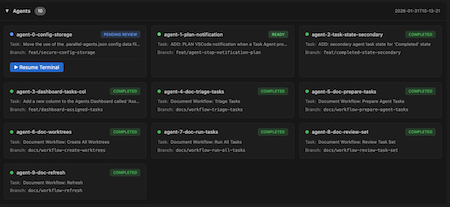
Worktrees to the rescue! An agent gets its own git worktree, its own task, its own context. They work independently, create separate branches, and submit their changes for review.
Happy days! Until merge time comes…
If one agent can do the work, why not have another do the review!?
I think you can see where this is going. Agentic task management can take you a long way and get you orchestrating a couple agents pretty quickly, no tools needed.
Simple Workflows
Bake-in these steps using scripts or automation and stop wasting precious human-review time!
- Task Breakdown - Break down large tasks. You can run many-agent’s now! Use them.
- Task Detail - Create clear descriptions with file references and acceptance criteria
- Create a Initialisation Pipeline - Automate creating worktrees and setting up agent configuration, don’t leave it up to the agent
- Assign Tasks - Assign tasks to specific agents in parallel, each working in it’s isolated worktree
- Review in Batches - Check the results, merge what works, iterate on what doesn’t
- Refresh - Update the board, bring in new tasks, repeat
The Numbers Don’t Lie
Get it right and you’ll see 100 commits a day regularly. Agent’s excel at small tasks with clear boundaries, let them handle the boring tasks while you focus on system design (or guiding long-running agents).
You only need to remember one thing, be clear with your instructions or start with a planning phase. “Extract inline values to shared constants in the document viewer” is a perfect agent task. “Fix the inconsistent number” (with no further input) is likely to cause more problems.
Things You Have to Accept
Task granularity matters more than anything else. Context is king. Talk through the plan. Make it clear. Break it down.
Conflict detection is non-negotiable. Catching two agents who have spent 10 minutes fighting over a config file is pointless. Treat your agents as a team.
Review time becomes the bottleneck. Generating code is fast. Verifying it’s correct takes longer. Reverting silly mistakes that made it to production is… you get it. The limiting factor has sshifted from “how fast can I code” to “how fast can I review.”
The Easier Way
We have built a Multi Agent Orchestration Platform that does everything mentioned here and much more.
Currently in closed early-adopter access and open beta soon!