Anthropic and OpenAI Agent Orchestration: Where the Giants Stand in Mid-2026
Multi-agent tooling from Anthropic and OpenAI, current capabilities, and what it means for developers building with AI agents.
When we first mapped this space in February 2026, our analysis centred on an experimental Agent Teams feature in Claude Code and OpenAI’s Agents SDK, alongside the emerging enterprise and standards layers around them. Five months later, a lot has changed, including a few of our own claims, which we revisit at the end of this post.
TL;DR: Both companies now ship multiple orchestration surfaces, and both have focused on server-side coordination. Here’s the mid-2026 state of play.
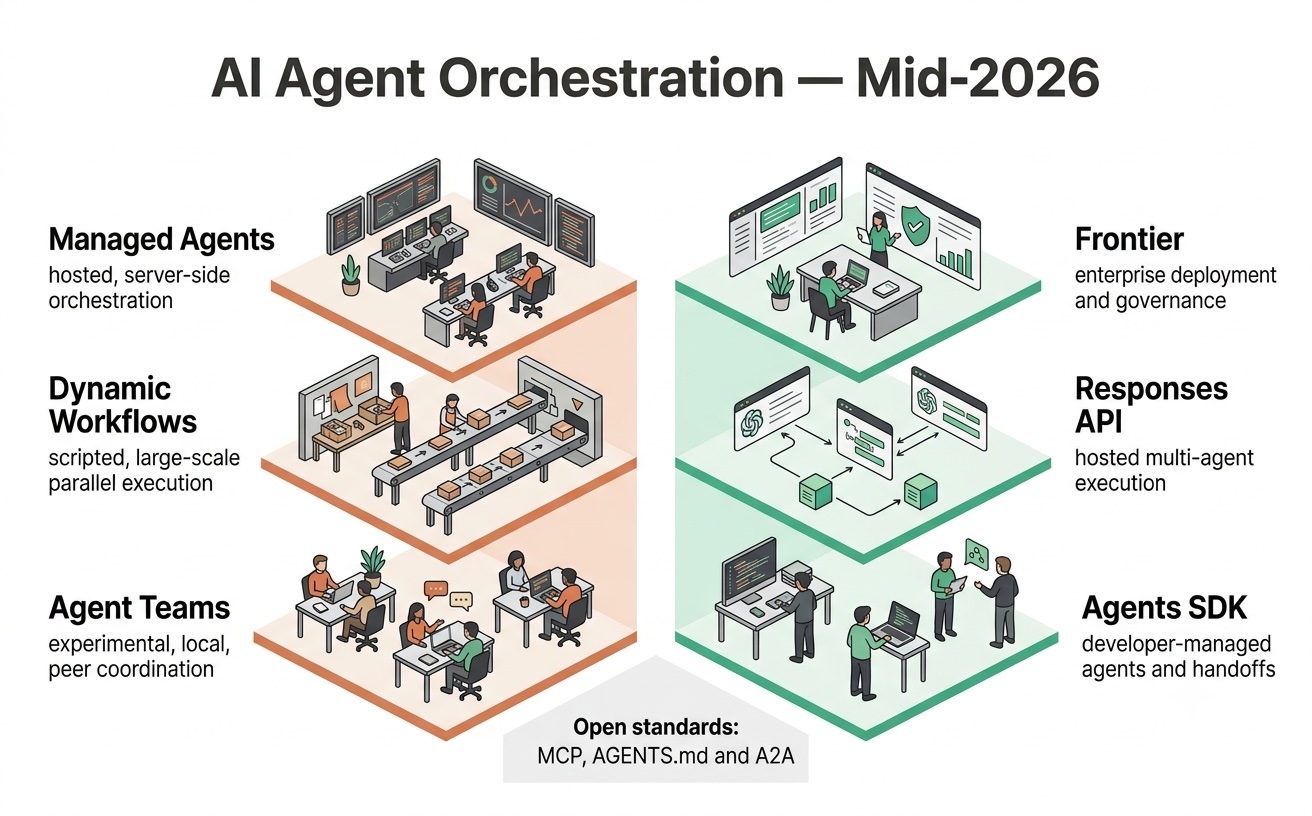
Anthropic: Three Ways to Run Agents in Parallel
Claude Code no longer has one parallelism story — it has three, each answering “who holds the orchestration plan?” differently.
| Primitive | Status | Who holds the plan |
|---|---|---|
| Subagents | Background by default | The main Claude session, turn by turn |
| Agent Teams | Experimental (opt-in) | A lead agent and a shared task list that teammates claim from |
| Dynamic Workflows | Generally available | An orchestration script Claude writes and a runtime executes |
Subagents became background-first in early July: the main session keeps working while subagents run, and agents launched headlessly can commit, push, and open a draft PR when they finish (Claude Code week 27 notes). Agent Teams remains experimental and disabled by default (the same CLAUDE_CODE_EXPERIMENTAL_AGENT_TEAMS=1 flag we documented in February), but it has been substantially redesigned: Claude creates the team state and attempts cleanup automatically, the in-process display keeps teammates in one terminal, teammates can be required to plan in read-only mode until the lead approves, and TeammateIdle / TaskCreated / TaskCompleted hooks provide programmable checks over teammate behaviour. Each teammate is a fully independent Claude Code instance with its own context window — only the task list and mailbox are shared (Agent Teams documentation).
Dynamic Workflows, introduced in late May and now generally available, Claude authors orchestration scripts that fan work across tens to hundreds of parallel subagents. Coordination happens outside the conversation, progress is checkpointed, and results are checked before they are folded into one response. Anthropic also warns that these runs can consume substantially more usage than a typical Claude Code session (Dynamic Workflows announcement).
Claude Managed Agents, Hosted
Claude Managed Agents, Anthropic’s hosted agent platform, entered public beta in April. Its multi-agent orchestration mode lets a coordinator delegate work to context-isolated specialist agents that share a sandbox and filesystem. July updates added broader lifecycle webhooks, session seeding, and per-thread event streams that let you watch an individual subagent’s output as it generates (Claude Platform release notes). This is Anthropic’s answer to server-side orchestration.
OpenAI: Consolidation Around the SDK and Frontier
OpenAI’s story since February is one of consolidation — and unsurprisingly this includes early deprecation of tools.
The Agents SDK Code-First Layer
An April re-architecture (“the next evolution of the Agents SDK”) added native sandboxing — agents execute in controlled workspaces with restricted file and code access — and a model harness handling instructions, tools, approvals, tracing, and resumable state (OpenAI’s announcement). The SDK has continued to add controls such as pre-approval guardrails and an experimental adapter for OpenAI’s hosted multi-agent capability.
OpenAI Agent Builder and Evals Platform Are Being Wound Down
Two prominent parts of the DevDay 2025 toolkit we described in February have been deprecated. OpenAI deprecated Agent Builder (the visual canvas) and the Evals platform in early June. Existing evals become read-only on 31 October; both products are scheduled to shut down on 30 November 2026. ChatKit remains available, and the recommended migration paths are the Agents SDK for code-first workflows and Workspace Agents in ChatGPT for natural-language workflows (OpenAI API deprecations).
Frontier, launched on 5 February, carries a separate enterprise ambition: building, deploying, and governing agents across company systems. As of July it remains available to a limited set of customers, with early adopters including HP, Intuit, Oracle, State Farm, Thermo Fisher, and Uber (Frontier announcement).
Assistants API Removal Date
One date every OpenAI developer using the Assistants API should have circled: 26 August 2026. OpenAI notified developers of deprecation a year earlier and schedules the API for removal on that date, with the Responses API as the recommended replacement (OpenAI API deprecations). The Responses API shape is also available on Amazon Bedrock through an OpenAI-compatible endpoint, so applications can use a familiar interface across OpenAI and supported Bedrock models (AWS announcement).
GPT-5.6
The GPT-5.6 family (9 July — sol, terra, and luna tiers) brought Programmatic Tool Calling, explicit prompt-caching controls, persisted reasoning, and a beta multi-agent mode in the Responses API. In that mode, a root model can create and coordinate parallel subagents without the application implementing the orchestration loop itself (OpenAI API changelog, multi-agent guide).
The Growing Standards Layer
The most consequential shift since February may be the one neither company owns outright.
- MCP’s next specification is scheduled for 28 July. Its release candidate replaces the protocol-level session with a stateless core, removing the
initializehandshake and session header so requests can sit behind ordinary load balancing without sticky sessions or a shared protocol-session store. MCP Apps and a Tasks extension cover server-rendered interfaces and long-running work (MCP release candidate). - A2A hit v1.0 in April with more than 150 supporting organisations, integrations in major cloud platforms, and reported production use across several industries (Linux Foundation milestone).
- AGENTS.md had been adopted by more than 60,000 open-source projects when the Linux Foundation announced the Agentic AI Foundation in December 2025. It became a founding project alongside Anthropic’s MCP and Block’s goose, with founding contributions from Anthropic, OpenAI, and Block (AAIF formation announcement).
Side-by-Side, Mid-2026 Edition
| Aspect | Anthropic | OpenAI |
|---|---|---|
| Developer-managed orchestration | Subagents, Agent Teams (experimental), Dynamic Workflows | Agents SDK: handoffs, agents-as-tools, code orchestration |
| Provider-hosted orchestration | Claude Managed Agents (public beta) | Responses API multi-agent mode (beta) |
| Coordination model | Shared tasks, peer messaging, scripted fan-out | Root/subagents, handoffs, agents-as-tools, guardrails |
| Enterprise governance | Claude Platform administration and Managed Agents | Frontier and Frontier Alliances |
| Open standards | AAIF co-founder; contributed MCP | AAIF co-founder; contributed AGENTS.md; supports MCP |
| Deadline to watch | Sonnet 5 promotional pricing ends 31 Aug | Assistants API removal scheduled for 26 Aug |
Looking back on our February Analysis
The OpenClaw concern remains unresolved. Anthropic contributed MCP to the AAIF, but Claude Code still reads its vendor-specific CLAUDE.md rather than AGENTS.md directly, and its native team and workflow primitives coordinate Claude agents rather than provider-neutral sessions (Claude Code memory documentation). Anthropic’s April restrictions on subscription-backed third-party harnesses were followed by a proposed Agent SDK credit scheme that it paused on 15 June, leaving its long-term commercial terms for third-party agent apps unsettled (Axios, Anthropic’s current notice).
Corrections to the February snapshot. Agent Teams teammates use independent context windows, sharing only the task list and mailbox (Agent Teams documentation). The comparison table also omitted Anthropic’s AAIF and MCP role, while the Agents SDK example did not match the supported Python interface using agents and Agent.as_tool() (AAIF formation announcement, Agents SDK documentation).
What aged fast. Opus 4.6 was followed by Opus 4.7, Opus 4.8, and Opus 5 within five months; Opus 4 and Sonnet 4 retired from the API on 15 June, making the 90.2% multi-agent result a historical rather than current benchmark. OpenAI also scheduled Agent Builder and Evals to close on 30 November and the Assistants API for removal on 26 August, while Frontier was already live when the February snapshot was published (OpenAI API deprecations).
What held up. Agent Teams remains experimental behind the same flag. Gartner’s end-of-2026 adoption forecast that “40% of enterprise applications will include task-specific AI agents” edges closer to reality. but Managed Agents, Dynamic Workflows, and the Responses API multi-agent beta all support the broader observation that multi-session orchestration remains an active product problem.
What This Means for Developers
The gap we identified in February is narrowing from above: the providers are climbing from in-session coordination toward managed, server-side orchestration. Their provider-hosted multi-agent modes are designed around their own model stacks. Teams that combine Claude Code, Codex, and framework-based agents still need a separate way to coordinate across those surfaces.
That’s where cross-provider control layers such as Flocker Agent Profiles can add:
- Cross-platform context management
- Real-time, cross-agent visibility
- Operational history
How do you coordinate agents across providers? We would love to hear from you! Email media@flocker.md
Selected primary sources:
- Anthropic: Introducing Claude Opus 5
- Anthropic: Redeploying Fable 5
- Anthropic: Dynamic Workflows in Claude Code
- Anthropic: Agent SDK subscription usage update
- Claude Code: Agent Teams documentation
- Claude Code: What’s New, Week 27
- Claude Platform release notes
- OpenAI: The next evolution of the Agents SDK
- OpenAI: Responses API multi-agent guide
- OpenAI: Introducing Frontier
- OpenAI API changelog
- OpenAI API deprecations
- MCP blog: release candidate for the scheduled 2026-07-28 specification
- Linux Foundation: A2A first-year milestone
- Linux Foundation: Agentic AI Foundation formation
This article has been updated. See our archive for the Feb 2026 post.